Is Spray Foam Insulation Worth It in Arizona?

Spray foam insulation can deliver strong value in Arizona homes where cooling demands drive energy use for much of the year.
Is spray foam insulation worth it in Arizona? In many cases, we find that it delivers measurable benefits in cooling-focused homes by combining insulation with air sealing. This dual function reduces attic heat transfer, cuts AC runtime by an estimated 10%–20%, and improves indoor comfort, especially when ductwork runs through superheated attics.
Key Takeaways
- In Arizona’s extreme heat, we treat air infiltration as just as critical as R-value, and spray foam addresses both in one installation.
- Homes with HVAC ducts in 140°F–160°F attics often experience greater performance gains than homes that are already tight and well insulated.
- Spray foam costs more upfront than fiberglass or cellulose, yet it offers long-term durability and won’t sag or settle over time.
- Roof deck installations can create a conditioned attic, which improves duct efficiency but requires careful ventilation planning.
- We see the strongest return for homeowners who plan to stay long term, face high cooling bills, or deal with comfort issues and noticeable air leaks.
What Most Arizona Homeowners Want to Know: Does Spray Foam Actually Pay Off?
The real question behind is spray foam insulation worth it comes down to performance versus cost. In Arizona, insulation is about blocking heat from getting in and reducing air conditioner runtime, not holding warmth during long winters.
Spray foam stands out because it acts as both insulation and an air barrier. In a state where attic temperatures regularly reach 140°F–160°F in summer, stopping hot air from entering the building envelope makes a measurable difference. Fiberglass and cellulose slow heat flow. Spray foam slows heat and seals cracks at the same time.
In practical terms, spray foam energy savings often fall in the 10%–20% range on combined heating and cooling costs, depending on home size, duct location, existing insulation, and air leakage levels. Results vary. Homes with ducts in a superheated attic or significant air gaps usually see stronger improvements than homes that are already tight and well insulated.
We also look beyond utility bills. Value shows up in more even indoor temperatures, fewer hot and cold spots, reduced dust, and improved long-term durability. In Arizona’s climate, spray foam insulation Arizona projects usually deliver the strongest returns where attic heat and air leakage are driving comfort problems.
Why Arizona’s Extreme Heat Changes the Insulation Conversation
Arizona is a cooling-heavy environment. Summers are long and intense. Winters are comparatively mild. That shifts the insulation focus from heat retention to heat rejection.
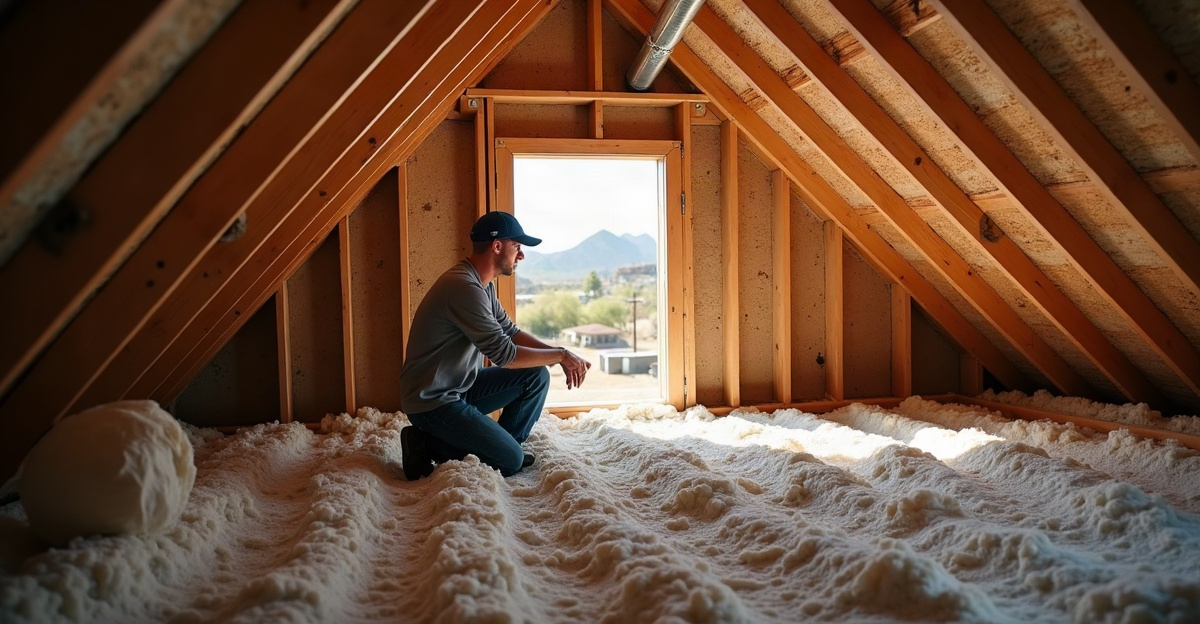
Attic temperatures commonly hit 140°F–160°F during peak summer conditions. If ductwork runs through that attic, the HVAC system pushes conditioned air through a furnace-like space before it reaches the rooms below. That raises cooling costs and reduces system efficiency.
Most Arizona homes share similar features:
- Vented attics with HVAC ducts above the ceiling
- Tile roofs that hold and radiate heat
- Stucco exteriors
- Slab-on-grade foundations
These design elements make attic performance especially important.
Monsoon season introduces another factor: humidity and dust. While Arizona is dry much of the year, seasonal storms drive moisture-laden air and fine particulates into attics and wall cavities. Air sealing helps limit those pathways.
Spray foam expands into small gaps and penetrations around top plates, wiring, plumbing, and roof decking seams. By reducing uncontrolled air movement, it helps manage heat gain and limits moisture intrusion during storm events. In this climate, controlling air infiltration is often as important as R-value. High R-value without air sealing leaves gaps that allow superheated attic air to circulate into living spaces.
What Spray Foam Insulation Costs in Arizona
Spray foam carries a higher upfront cost than fiberglass batts or blown-in cellulose. That’s a realistic starting point.
Open-cell spray foam in attics or walls typically costs more than traditional insulation materials. Closed-cell spray foam costs even more per inch but delivers a higher R-value per inch and adds structural rigidity. The right choice depends on the application and performance goals.
New construction generally costs less per square foot than retrofit work. Access is easier. Surfaces are exposed. Labor is more efficient. Retrofit installations may require removing existing insulation, improving ventilation setups, or working in tight attic spaces.
Attic roof deck applications—where we insulate along the roofline to create an unvented, conditioned attic—cost more than insulating the attic floor. That approach changes how the attic performs and directly benefits ductwork located in that space.
Pricing depends on several factors:
- Accessibility of the attic or wall cavity
- Foam thickness required to meet energy goals
- Roofline complexity
- Ventilation adjustments
- Removal and disposal of old insulation
While exact numbers vary by project, spray foam is a higher upfront investment. We evaluate it based on lifecycle value. Properly installed foam does not settle like some loose-fill products and can last the life of the structure. That long-term durability plays a major role in overall return.
For homeowners comparing options, reviewing our spray foam insulation services helps clarify how different applications affect both cost and performance.
Spray Foam vs. Fiberglass and Cellulose in Arizona Homes
Every insulation type has strengths and tradeoffs.
Fiberglass batts are widely used and affordable. Performance depends heavily on correct installation and careful air sealing. Gaps, compression, or misalignment reduce effectiveness.
Blown-in cellulose offers good coverage at a moderate cost. It fills irregular spaces better than batts but can settle over time, reducing effective R-value if not installed properly.
Spray foam insulation Arizona applications combine insulation and air sealing in one step. That dual function sets it apart, especially in hot attics with ductwork. Reducing air leakage in that environment can prevent conditioned air loss and limit heat infiltration from above.
Spray foam makes the most sense in situations like:
- Homes with HVAC ducts in the attic
- Converting to an unvented conditioned attic
- Metal buildings
- New construction or major remodels with open wall access
There are also cases where spray foam may not provide a strong return. Homes with already well-sealed building envelopes and minimal duct exposure may see smaller improvements. Projects focused strictly on the lowest initial cost usually favor fiberglass or cellulose.
A clear understanding of spray foam pros and cons helps set realistic expectations instead of assuming it’s automatically the best solution in every scenario.
Spray Foam Pros and Cons: What to Consider Before Deciding
Here’s a straightforward breakdown to guide decisions:
- Air sealing and insulation combined in one material
- Potential spray foam energy savings in the 10%–20% range, with results varying by home
- Improved indoor comfort and more consistent room temperatures
- Reduced dust and allergen infiltration
- Long lifespan with minimal settling
There are tradeoffs to consider:
- Higher upfront cost
- Installation quality is critical; poor mixing or application reduces performance
- Temporary off-gassing during curing; occupants may need to vacate briefly
- Ventilation adjustments required for unvented attic conversions
- Limited retrofit options in closed wall cavities without demolition
Roof deck applications involve spraying foam directly against the underside of the roof sheathing. This moves the thermal boundary from the attic floor to the roofline. The attic becomes part of the conditioned space. Ductwork then operates in a moderated environment instead of extreme heat. Proper ventilation strategy is essential in this setup to maintain indoor air quality and manage moisture levels.
Experience matters. Proper installation ensures foam adheres correctly, expands fully, and meets thickness targets. Reviewing project details and common concerns in our insulation FAQ can clarify expectations before moving forward.
When Spray Foam Is Worth It—and When It May Not Be
Spray foam is often worth the investment for:
- Homes with high summer cooling bills and visible comfort issues
- Properties with noticeable air leakage
- Attics where ductwork is exposed to extreme heat
- Long-term homeowners planning to stay 10+ years
It may not be the best fit for:
- Short-term ownership timelines
- Tight budgets where payback speed is the top priority
- Homes that first need simpler air sealing improvements
Every property performs differently. Attic design, duct location, insulation depth, and overall building tightness all influence outcomes. A home in Phoenix may have very different performance challenges than one in Tucson, even with similar square footage.
A property-specific assessment provides clarity. For homeowners evaluating whether spray foam insulation is worth it in their situation, we recommend scheduling a professional review through our Arizona insulation team. A focused evaluation ensures the solution fits the building, the budget, and the long-term plan.