How Does Spray Foam Insulation Work? Homeowner’s Guide
Homeowners often ask how spray foam insulation works. We explain it as a two-part chemical reaction that expands on contact, bonds to surfaces, and cures into a continuous air and thermal barrier. The material fills cracks, seals air leaks, and delivers high R-value per inch in attics, walls, crawl spaces, and metal buildings. We use it to control heat transfer, limit moisture movement, and reduce HVAC strain when we design and install it correctly.
Key Takeaways
- We apply spray foam as a heated liquid that expands 30–60 times its original size, adheres to framing and sheathing, and cures into a solid insulating layer. This expansion lets us seal gaps that other insulation types often miss.
- We reduce heat transfer and uncontrolled airflow with a single application, which improves comfort, stabilizes indoor temperatures, and lowers energy demand. Consistent air sealing also helps HVAC systems run more efficiently.
- We choose open-cell foam for flexibility and sound control, while we select closed-cell foam for higher R-value per inch, added rigidity, and stronger moisture resistance. Each option serves a clear purpose based on the structure’s needs.
- We often see spray foam outperform fiberglass and cellulose in air sealing and durability, yet we match the material to the budget, assembly design, and climate. The right specification always drives better results.
- We know installation quality, building layout, HVAC configuration, and local conditions directly influence long-term performance. Careful planning and skilled application ensure the insulation performs as expected for years.
What Spray Foam Insulation Actually Does Inside Your Home
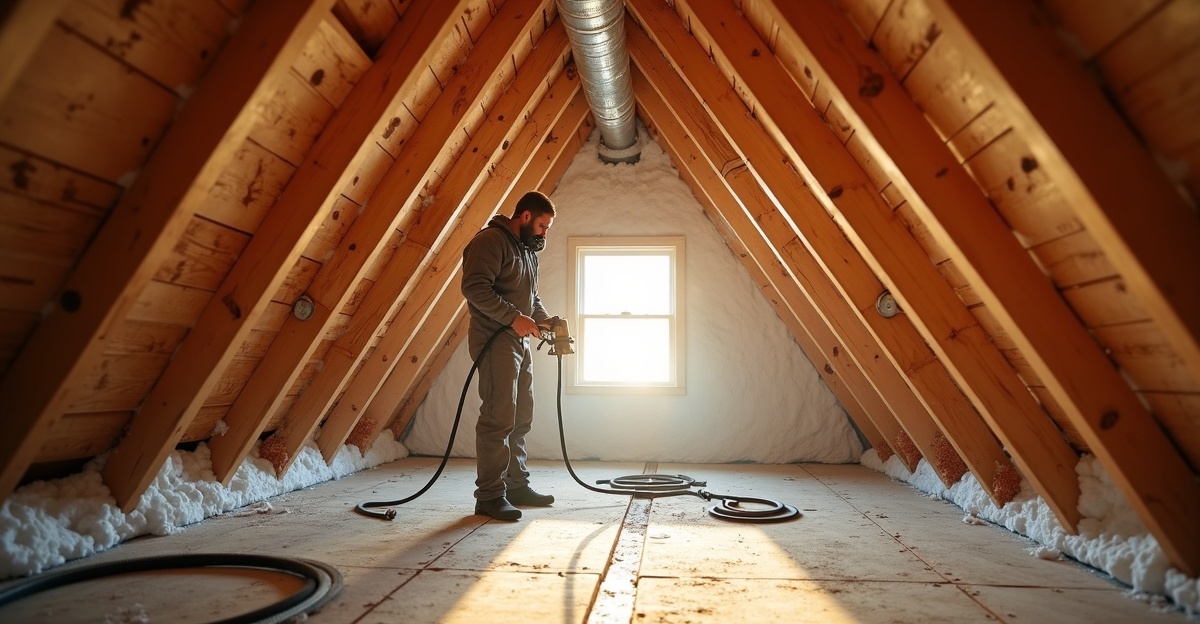
Spray foam insulation works through a two-part chemical reaction that happens at the job site. One component is isocyanate and the other is a polyol resin. We heat both materials and spray them together as a liquid. Within seconds, they react, expand rapidly, and harden into a solid insulating layer.
That basic reaction answers the core question: how does spray foam insulation work? It goes on as a liquid, expands up to 30–60 times its original volume depending on the type, and then cures into either a rigid or semi-rigid foam. During expansion, it fills cracks, gaps, and voids that other insulation materials often leave behind.
The process follows a clear sequence:
- Liquid application through heated hoses and a spray gun
- Rapid expansion as the two components mix
- Strong adhesion to wood, metal, masonry, and drywall
- Curing into solid foam that stays in place
This expansion and adhesion are what set it apart. The foam bonds directly to framing members, roof decks, and wall sheathing. It forms a continuous layer that acts as both insulation and an air seal in one step.
Traditional insulation slows heat flow, but it doesn’t stop air movement. Spray foam reduces both heat transfer and uncontrolled airflow, which are two major causes of energy loss in homes. That’s why homeowners asking “does spray foam insulation work?” often notice changes in comfort before they even see changes on utility bills.
In practical terms, this means reduced air leakage, steadier indoor temperatures, and less strain on HVAC systems. Rooms that used to feel hot in summer or drafty in winter become more stable. Ductwork in attics operates in a less extreme environment. The system runs more efficiently because conditioned air stays inside the living space instead of escaping through gaps.
For a deeper technical breakdown, our guide on what is spray foam insulation and how it works explains the chemistry and building science behind the material.
How Air Sealing and Thermal Barriers Improve Comfort and Energy Efficiency
Insulation and air sealing solve different problems. Insulation slows heat flow. Air sealing stops uncontrolled air movement.
Heat flow is measured by R-value, which represents resistance to heat transfer. The higher the R-value per inch, the greater the insulating performance in less space. Closed-cell spray foam, for example, provides higher R-value per inch than many traditional materials, which helps in tight framing cavities.
Heat moves in three primary ways:
- Conduction: direct heat transfer through solid materials like wood or drywall
- Convection: heat carried by moving air, such as drafts through gaps
- Radiant heat: heat energy radiating from hot surfaces, like a superheated roof deck
In hot climates such as Arizona, radiant heat from the sun drives attic temperatures extremely high. Conduction transfers that heat into living spaces. Air leakage through recessed lights, top plates, duct penetrations, and attic access points allows superheated air to enter the home.
Spray foam addresses conduction by providing high R-value insulation. It addresses convection by sealing the cracks and gaps that allow hot air to move freely. In the case of closed-cell foam, it can also function as a vapor retarder depending on thickness, which helps manage moisture during monsoon season.
This dual function is why homeowners often ask, spray foam insulation how does it work so well in extreme climates? The answer lies in controlling multiple forms of heat transfer at once. By creating a continuous air barrier and thermal boundary, spray foam reduces temperature swings and helps maintain indoor comfort.
Performance still depends on proper installation and overall building design. HVAC sizing, attic configuration, and ventilation strategy all matter. When installed correctly, spray foam can significantly reduce cooling demands in homes with ductwork in hot attics. In Arizona homes, that difference can be noticeable in both comfort and system longevity.
If we’re evaluating project priorities, we also discuss is spray foam worth it in Arizona based on real-world heat conditions and home construction styles.
Open-Cell vs. Closed-Cell Spray Foam: Key Differences That Matter
Spray foam falls into two main categories: open-cell and closed-cell. Each has distinct properties that affect performance and cost.
Open-cell spray foam has a lower density and a softer texture. It expands at a higher rate, which allows it to fill cavities quickly. Its typical R-value ranges from about R-3.5 to R-4 per inch. It remains vapor permeable, which can be beneficial in certain wall assemblies, and it offers strong sound control for interior partitions.
Closed-cell spray foam has a higher density and cures into a rigid structure. Its R-value typically ranges from about R-6 to R-7 per inch. It has low vapor permeability and can add structural rigidity to walls and roof assemblies. It also provides additional resistance to moisture intrusion.
Climate, budget, and available space influence material choice. In hot, dry areas, higher R-value per inch can help where framing depth is limited. In mixed-humid environments, vapor control may be a bigger factor. Construction assemblies with long spans or metal framing might benefit from the added rigidity of closed-cell foam.
Neither type is universally better. Each addresses different building challenges. The final R-value and air sealing performance depend on thickness and consistent application. Even the best material will underperform if coverage is uneven or voids are missed.
For a side-by-side breakdown, our comparison of open-cell vs closed-cell spray foam walks through ideal applications in more detail.
Where Spray Foam Performs Best: Attics, Walls, Crawl Spaces, and Metal Buildings
Attics are one of the most effective areas for spray foam. By insulating the roof deck instead of just the attic floor, we can bring the attic into the conditioned envelope. That stabilizes attic temperatures and protects HVAC equipment and ductwork from extreme heat.
Walls also benefit, especially in retrofit projects where irregular cavities and existing penetrations create leakage paths. Spray foam conforms to odd shapes and framing variations. In new construction, continuous coverage helps create a well-defined thermal boundary. The wall spray insulation service is often recommended when energy performance is a high priority.
Crawl spaces can see improvements in moisture and air control when the design includes proper moisture management and ventilation planning. Foam applied along foundation walls and rim joists helps reduce outside air infiltration.
Metal buildings and commercial structures benefit from spray foam’s adhesion and high R-value per inch. It helps control condensation on metal panels and supports temperature regulation in large open spaces.
Performance depends on thoughtful design. An unvented attic assembly may require additional ventilation or mechanical systems to maintain indoor air quality. HVAC equipment may need adjustment if the building envelope changes significantly. Our experience with attic retrofits and air sealing in Arizona’s hot, dry climate makes proper planning a priority on every project.
How Spray Foam Compares to Fiberglass and Cellulose
Spray foam, fiberglass, and cellulose each have strengths. A fair comparison helps set realistic expectations.
Spray foam provides built-in air sealing. Fiberglass and cellulose typically require separate air sealing measures to address leakage points. Without those measures, air can move through or around the insulation.
R-value per inch also differs:
- Spray foam: about R-3.5 to R-7 per inch depending on type
- Fiberglass: about R-2.5 to R-3.7 per inch
- Cellulose: about R-3 to R-3.8 per inch
Closed-cell spray foam resists moisture and maintains performance if exposed to humidity. Fiberglass can lose effectiveness when compressed or wet. Cellulose can absorb moisture and may settle over time.
Durability is another factor. Spray foam adheres to surfaces and does not typically settle. Blown-in fiberglass and cellulose can shift or settle, reducing effective R-value if not installed correctly.
Cost varies by material and scope. Spray foam generally carries a higher upfront investment. Fiberglass and cellulose usually have lower initial costs. Each option can perform well when installed properly and matched to the right application.
Does spray foam insulation work better in every situation? No. Project size, framing depth, budget, and long-term goals matter. In some homes, a combination of materials may make sense. Our overview of the best insulation for Arizona homes outlines how we evaluate those decisions.
Factors That Influence Performance and What Homeowners Should Consider
Installation quality is critical. Improper mixing ratios, inconsistent spray thickness, or missed gaps reduce performance. Spray foam must be applied evenly and at the correct temperature to cure properly.
Building design also affects results. Roofline complexity, recessed lighting, duct placement, and framing depth all shape how well the system performs. Tighter homes may require mechanical ventilation to maintain healthy indoor air quality.
Climate plays a major role. In Arizona, extreme heat and high solar gain push insulation systems hard. Monsoon season adds occasional moisture loads that assemblies must manage. Spray foam insulation how does it work in extreme heat? It limits hot air intrusion and reduces heat transfer from roof decks into living spaces, provided the system is installed correctly.
Homeowners also ask, how does spray foam insulation work in older homes? In many cases, it fills irregular cavities and seals long-standing air leaks. However, we first evaluate existing insulation and structural conditions before making recommendations.
Another common question is how well does spray foam insulation work compared to blown-in insulation? Spray foam generally outperforms in air sealing and R-value per inch, while blown-in materials can be cost-effective for adding attic depth if air leakage is addressed separately.
Energy savings vary from home to home. We avoid fixed percentage promises. Instead, we assess current performance, project scope, and budget to determine if spray foam is justified. In some cases, existing insulation and air sealing may already perform adequately.
We encourage scheduling an evaluation to review attic conditions, ductwork location, and insulation levels. Our spray foam insulation services focus on practical results and long-term performance. Homeowners can also explore additional resources in our insulation blog or request a personalized assessment through our contact page.